Monday, July 4, 2011

A Day in Petra

On the day off the team travel to world famous site of Petra to take a visit. Petra was the captial of the Nabataeans, an Arab Kingdom which florished from about 100 BC to AD 100. They became rich from the trade routes which they controlled which connected the Far East (China and Indis) to the Middle East and Rome. The site is a UN World Hertiage site and has was named in the modern list of the seven wonders of world. You can hike in and out or ride on horses, camels, or donkeys.

After walking for about a mile you enter a beautiful gorge called the Siq. The stone all around Petra is Nubian sandstone which has beautiful veins of color. Because of this narrow entrance the location of the city was unknown to outsiders for over 1000 years. In the early 19th century the Swiss explorer Johann Burckhardt "discover" the site. He was in disguise as a muslim pilgram to see the shrine of Aaron which is on top of a nearby mountain. This photo captures the beautiful of the Siq and the wonderful moment when you round a bend and get your first glimpse of the famous Treasury.

Here is the Treasury made famous in the Indiana Jones movie. It is actually a tomb. The outer "architecture" is actually carved from the bedrock as a facade. This is a favorite place for photos and a camel rides.


This is the staircase that leds up to the High Place which has an altar of sacrifice. It is a tough climb up but the view is well worth it. The stairs are carved into the sandstone.


Here is a view of the red sandstone mountains as seen from the High Place.

Here is a picture of some of the team that climbed up to the high place. From left to right in the back row Philip Eubanks, Mike VanZant, Melissa VanZant, Melissa Hope, Thomas Wowros, Daniel Hoffman, Jerome Prinston, in the front Jody Owens, and Jeremiah McLeod.


This is great view of Jebel Haroun which in English is the mountain of Aaron. On the peak you can see the shrine to the prophet Aaron the brother of Moses. Aaron is recoginzed as one of God's prophets according to the Quran. 

This a view from inside one of the rock cut tombs, this give you a sense of what they look like and how they were constructed.


  This photo highlights the beautiful colors of the sandstone that change as sun moves. There is no place like Petra and one visit only scratches the surface of this wonderful place.

John Wineland
Amman, Jordan


Sunday, July 3, 2011

Update Reporting from Amman

Greetings,

The day off from the dig, and some much needed rest. The crew traveled to Petra (more on that later). One of those on the sick list, Don Garner, headed back rejoin the work at the excavation. Several people(about 9) headed for home since they had only schedule to be at the excavation for the first half. Two of us are still in Amman, Jerry and John. Jerry is feeling better and hopes to return to work this week. I am also feeling much better but I need to go home early to make sure this foot is completely healed.

Here are some pictures from the work on the site.


This is a great view of our site from the Fajj (the valley to the east of the site) You can see the walls of the fortress and the small building where we store our equipment during the dig.

We divide the excavation into Fields or Areas of excavation which we label with a letter. This is Field D on a cloudy day (which is a rare thing) You can see the squares and the Iron Age wall lines and pavements. This field is in the northwest section of the fortress.

The supervisor of the work in Field D is John Mark Wade pictured here holding dustpan. (photo submitted, we have not analyized it yet for any photoshop altering)


We do a variety of work on the site. Here Adam and Leslie Bean excavate together using small trowels and dustpans. They will be moving after the excavation to Baltimore where Adam will begin his doctoral studies at Johns Hopkins University. They are our only couple at the dig.


There are many other activities on the site. First thing in the morning is a progress photo. We use a meter stick marked with black and white section which are 10 centimeters long. This provides scale to the photorgraph. Also we use the arrow to point to north.


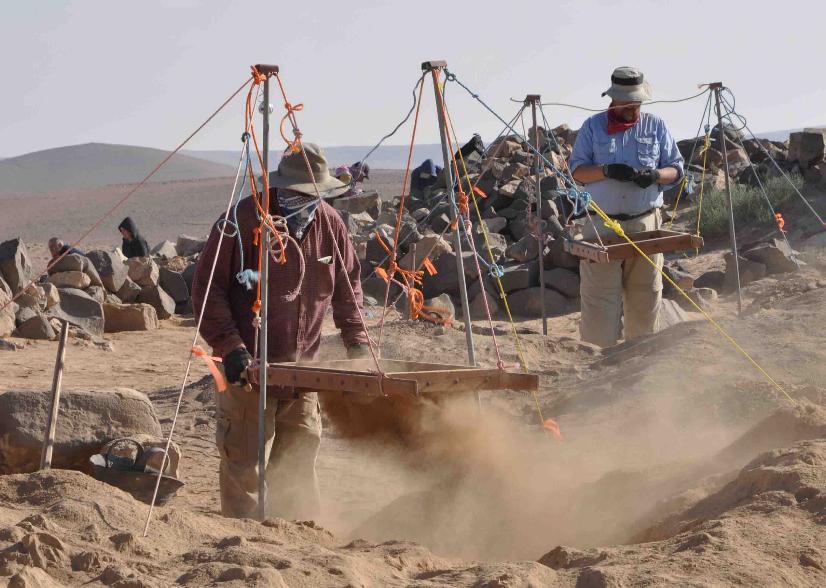
Another big job and an important one is shift the soil from the squares. It is at the shifts that we find the pottery, metal, and bones being excavated. It is hard and dusty work.


There is also a great of drawing to be done. This is a top plan. It is a "birdseye" view of the square. Each square is drawn each day and final top plan drawings are made at the end of the excavation. We also draw all of the "walls" or balks of the square too.

Another job is trimming the balks so they straight. This way we have clearer idea of the layers that the excavators dug through. These layers are very important because we seperate the artifacts from each layer to determine the dating of the layers.


We do get some beautiful sunsets, here is another.


John Wineland
Amman, Jordan

Friday, July 1, 2011

Update

Hello
There has been no blog for a few days. I have been in Amman and much of that time I did not have any internet. In fact I have been in the hospital because of an infection my foot. I am in the hospital and will have to head for home soon. I will continue the blog with the help those whu will stay at the dig. Most of the time our medical problems at the excavation are not serious. We bring with us first aid kits, bandages, and over the counter medicines. Also many team members bring there own supply of antibiotics, pain killers, etc.
Most of our medicial problems are usually deal with minor stomach problems and scrapes. But sometimes things get more serious. We have contacts in Amman and access to the best care in the country. So this week 3 members have come to Amman for treatment. One for vertigo (Don Garner), my infection, and a third for a kidney stone (Jerry Mattingly). All is well one member is heading back to the field (Don). I need to head home. The third member (Jerry) will be here for a few days and then he should be able to return to the excavation.

I will continue the blog as best I can from Amman and later from home.

Here are a few pictures from this week.


Here we see Tim Snow the photographer on the left in Field D with a human sun shield for the photos.


This pottery "reading". Each day we do pottery reading to determine the dates that the pottery was made. This helps us determine the date of the layer of soil where the potter was found. Leslie Bean is on the left on the top is Adam Bean. On the right is Jerry Mattingly. 


In field D Thomas, one of out team members from Germany is excavating.


There can be dangerous things hiding in the squares and under rocks. Here is scorpion found in Field D.

I will try to send another entry as soon as I can.

John Wineland
Amman, Jordan

Tuesday, June 28, 2011

Another day of Digging

We are moving along in our work and finding some interesting things along the way.


Whenever we excavate we open up our branch of CSI Mudaybi. Here we see the CSI team photographing a human skeleton in a square near the gate of the fortress. Notice how they shade the area so there will be better lighting for photos. How did the this person die? And when? These are all questions we ask. In this photo Tim Snow is taking the picture, Front left is Leslie Bean, top left Jerry Mattingly, the Adam Bean, Any Stickler, and Josh Carter.


Here we have shot of a Bandito in action. The Bandito Jerome Prinston. Front left is Thomas Wowros, and in the center is Melissa Hope.


We get up very early (about 3:30AM) so it is long day and you need to nap when you can. Here on the bus we have Michael VanZant (left) and Jody Owens getting some shut eye.


This picture was contributed by Mark Green. A nice picture of a camel in the morning light.


We have beautiful sunrises and sunsets here in Jordan. Here is another nice shot submitted by Philip Eubanks.

John Wineland
Jordan

Sunday, June 26, 2011

Week 2: Back to Work

After resting over our "weekend" it was time to get back to work on Sunday. Today I will feature a variety of scenes of our work.


Adam Bean is a first time worker at KRP. He is graduate of Johnson University and Immanuel Christian Seminary and is headed to Johns Hopkins University in the fall.

Here are two first time participants Ronaldo Denuna (left), Amy Stickler (center), both students at Garner Webb University with veteran Michael VanZant, professor at Mount Vernon Nazarene University, listening announcments before our evening meal.


This is Jerome Prinston, profession at Johnson University, another first time member of the team. I think he must normally spend his summers working for the Secret Service.


Here is the project leader Jerry Mattingly, Johnson University and our driver Hussein, both have worked with KRP since 1995.


Here is a view from the site looking out over the Fajj. The fajj served as a trade route in antiquity.


Here are two first time workers, Dwayne Howell, professor at Campbellsville University and Jerome Prinston, professor at Johnson University.


Here is part of the crew looking over the work at the site. From left to right in the front row, Adam Bean, Josh Carter, Philip Eubanks, Thomas Wowros, Gerald Keown, second row left to right, Ronaldo Denuna, and Melissa Hope.


We travel by bus to the site but in pinch we could ride camels!

Here we can see some camels in the Fajj. Many camels are brought to Jordan from Saudi Arabia in the summer because by comparsion Jordan is cooler and has more vegetation for the camels to eat. The camel is sometimes called the "ship of the desert" because it is so well designed for life in the desert and was used as transportation for humans and goods. Bedouins use the camel for many purposes, of course for transportation but also they eat the milk of the camel, use camel skins to make their tents, and camel is considered by many to be special meal for certian holidays (the "turkey of the desert"?) 

Here sitting on the tower of the Iron Age gate at the site is left to right, Michael VanZant, Leslie Bean, and Melissa VanZant.

It gets a little dusty at the site as we can see from this photo of Jody Owens, professor at Johnson University.


(Special note: The above photo is NOT staged.) Here we see, holding the sledgehammer, John Mark Wade, librarian at Emmanel Christian Seminary.*

Here in a more familiar pose is John Mark Wade.
To end on a happier note, here is the sunrise over the Fajj as seen from the site.

John Wineland
Jordan

* Editor's note [Editors have been pressed to print things since at least the time of Guttenberg. As editor of this modest endeavour, I have prided myself, up to this point, in the fact that I have always strived to avoid "yellow journalism." However I regret to inform you that I too have finally been force to yield to the pressures all editors face. (You would think that a librarian would be more sensitive to the issues of censorship and propaganda.)]

Saturday, June 25, 2011

The End of the First Weekend

Greetings,

We have completed one full week of excavation and our first "weekend." As I told you before the weekend in Jordan is Friday and Saturday instead of Saturday and Sunday. So things here are more like this:
Thursday = Friday
Friday = Sunday
Saturday = Saturday
Sunday = Monday
So that means we will get back to work on Sunday but for today we spent it resting, doing laundry, shopping, studying, reading, and get caught up on paperwork. One part of our team did take a trip to the Dead Sea.

It gets dirty out on the site, with a great deal of wind blown dust. I have never seen a laundry mart in Jordan so most people wash their clothes in a bucket like this.


Then we hang it up in our rooms on lines with clothes pins to dry. Things dry quickly because the air is low humidity.

Yesterday I did not finish showing you pictures from our trip up the King's Highway, the last place we stopped was al-Rabba a Roman-Byzantine site with ruins in the city of the town.

Here we see Philip Eubanks and Adam Bean taking photos over the fence at the site.


Here Friedbert Ninow prepares to photograph the site and the crew at Rabba.


If you look carefully you can see a crescent moon faintly visible over the Roman capital at Rabba.


The Department of Antiquities preserved this site. Here they stacked up several capitals that once stood along the Roman road. The modern road that runs through Rabba follows the path of the ancient King's Highway and the Roman road (Via Nova Traiana or the New Road of Trajan).

This is the Nabatean Temple at Rabba. The Nabateans had their famous capital at Petra. It was an Arab kingdom that contolled trades of precious items from the east (silks and spices) and transported it across the desert to the Mediterranean areas. They became rich from this trade and florished between 100 BC and AD 100. In AD 106 the Romans during the reign of Trajan took their land and established the Province of Arabia.

Here is an excellent picture of the valley leading down to the Dead Sea. The Dead Sea is the lowest spot on the face of the earth 1388 feet below sea level. In the center of the photo in the haze you can see the Dead Sea.  In the distance on the other side of Dead Sea is the modern state of Israel.

As you descended into the Jordan Valley the tempature increases greatly. The Dead Sea/Jordan river valley is warm enough to grow tropical fruits like bananas and date palms.

The Dead Sea has been shrinking over the past 50 years and is now much smaller than it was. The water from the Jordan River flows into the Dead Sea but not out. The water evaporates and this is why the water in the Dead Sea is salty, it is over 33% salts. This is extremely salty, for example the average salt levels in the ocean is less than 4%. The shrinking of the Dead Sea is caused from the diverting of the water which flows into the Jordan River and on to the Dead Sea. Israel diverts a great amount of water before it enters the Jordan River. Also as you saw earlier Jordan has built and is building dams along the rivers which run to the Dead Sea and the Jordan River.

Here a photo of the group that traveled to the Dead Sea from left to right, Daniel Hoffman, Melissa VanZant, Jody Owens, Philip Eubanks, Mark Green, Christiann DaSilva, and Michael VanZant.

We needed these days off to recover from the week and get ready for another week of work.

John Wineland
Jordan